If AI lets you finish in six hours what used to take eight, what happens to the other two?
Most answers are about volume and speed. Fewer people ask the question underneath: what are we optimizing for, and why? That’s where the human work begins.
None of this is a reaction to AI. The question of how people stay clear, aligned, and human inside systems asking something different of them predates this moment by decades. AI has simply raised the stakes and shortened the timeline.
The work is seeing the system clearly, naming what’s unsaid, aligning people to priorities, and building the capabilities to lead in context. Where technology and humanity don’t compete. They compound.
As an independent practice, HBD works with leadership and cross-functional teams, institutions, and cross-sector partnerships at critical inflection points: when the strategy is clear but execution has stalled, when the people who need to act together aren’t aligned, when change isn’t landing, or when technology is moving faster than the organization’s judgment and trust can keep up.
The clients who fit best share the belief that technology, people, purpose, and profit are not mutually exclusive. When leadership, teams, systems, and communities are aligned, greater impact follows.
Mexico City
Range & Record
Thirty years, one throughline.
The throughline across three decades has been the same: helping people navigate complexity together, wherever the room happens to be.
30
Years
Across corporate, civic, federal, and international work.
4
Continents
Lived and worked across four continents, translating strategy and building alignment across cultural and organizational lines.
Experience includes: KPMG · Deloitte · Microsoft · Lowe’s · UN Women · U.S. Department of Energy · City of Charlotte · Mecklenburg County Bar
Strategic Convening & Alignment
“One of the skills I admired most about working with Sharon was her ability to visually map out strategies and connections. She’s very good at distilling a lot of information down to its essentials and presenting it clearly to a diverse audience. She’s also a bridge builder, constantly looking for opportunities to connect people and ideas that benefit everyone, not just her own position, always keeping the bigger vision in view.”
Rob Phocas, Executive Director, Southeast Sustainability Directors Network
Philosophy
You can’t outperform a bad fit.
Most performance problems aren’t talent problems. They’re alignment problems — between people and roles, strategies and structures, stated values and lived experience. And they show up at every level: the individual, the institution, and the broader systems within which they operate.
Areas of Practice
Where I do my best work
Each designed for a specific kind of stuck — and for your situation, never a template.
Complexity rarely respects organizational boundaries. By looking across the landscape, I help clients surface hidden tensions and see the opportunities and points of breakage they might otherwise miss.
When the room is smart but stuck.
Your leadership team is talented. The strategy is sound. And yet things stay stalled. Meetings produce agreement but not action. The obstacle isn’t competence; it’s something beneath the surface that no one has named yet.
When the model that got you here won’t get you there.
Something has shifted — in your leadership, in your structure, in the world your organization is now operating in. There may have been departures. New voices at the table. A policy change. A transformation still in motion with no clear landing point. You can sense what’s needed, but could benefit from other perspectives. That’s when outside eyes matter most.
When everyone knows and nobody is saying it. (What’s the elephant in the room?)
There’s a question underneath the question. Everyone in the room feels it. No one is asking it. The longer it stays unnamed, the more energy it quietly consumes. That’s usually where I start.
When individual and collective strengths have room to grow.
Each leader brings real strengths. The team has strengths too, but no one has named or fully developed them, so people work around one another instead of with one another. Trust is thin, and honest conversations don’t happen. That’s when developing people and teams together matters most.
The Work
These moments share one thing: the obstacle isn’t information or intelligence. It’s what’s operating beneath the surface that hasn’t yet been seen, named, or resolved.
01
Executive Facilitation & Stakeholder Alignment
When the right people need to align on strategy and move forward together.
We clarify where you’re trying to go, whether the right people are aligned, and what’s standing in the way. Then we design and facilitate the conversations that move complex, multi-party decisions forward with built-in accountability, not just meetings that end with good intentions.
OutcomeThe real trade-offs named, an agreed-upon direction, and clear ownership of what comes next.
“…Sharon challenges perspectives, reframing a discussion to reach either a solution, a common vision, or strategic course of action.”
Kristen Beamer, Chief Marketing Officer, McKim & Creed · More from clients ↓
02
Leadership in Complexity
When leadership capacity must match the complexity of the moment.
We facilitate strategic planning conversations that clarify direction, test assumptions, and bring vision, mission, and values into focus. We offer recommendations informed by the organizational, geopolitical, and technological forces shaping your work. Together, we strengthen the judgment leaders need to navigate change, and turn shared direction into sound decisions.
OutcomeA clear strategic direction, informed choices, and stronger judgment to navigate complexity and change.
“Sharon mastered everything we tasked her with, often with very abstract instruction from our organization.”
Michael Martinez, Partner, Grier Wright Martinez, PA · More from clients ↓
03
Individual & Team Development
When you’re growing as a leader, navigating a transition, or helping your team work better together.
We help individuals understand their strengths, clarify how they want to lead, and navigate the challenges of their roles. We help teams build trust, speak honestly, and draw on each person’s strengths to work well together. Through individual coaching, strengths-based sessions, and shared team experiences, we build capabilities that last beyond our time together.
OutcomeGreater self-awareness, confidence in how you lead, and stronger working relationships.
“Spending time with Sharon and having her help me reframe the way I view my values and strengths was nothing short of life changing.”
Jeremy B. Tomes, Founder and Board Chairman, Prime Contractor Supply · Bar Leadership Institute participant · More from clients ↓
Ways to Begin
Five ways in, from a focused first step to an ongoing partnership. Every engagement begins by agreeing on what success looks like, and how we’ll know.
01
Human by Design Diagnostic
For leaders who sense something is stuck and need to know why before acting.
Confidential conversations with the people closest to the work, synthesized into a clear read of what’s holding things back and a recommended path forward.
02
Alignment Lab
For leadership teams that need to agree on a direction and move forward together.
A facilitated working session that brings the real trade-offs into the room and ends with an agreed-upon direction, clear ownership, and a strategic roadmap for the work ahead.
03
CliftonStrengths® for Leaders & Teams
For leaders and teams who want a shared language for how people contribute best.
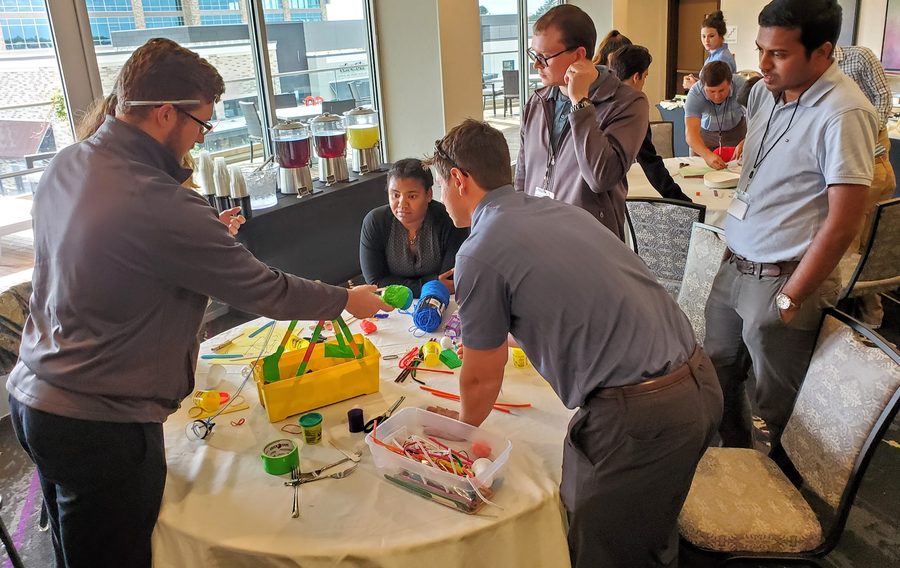
Individual and team strengths sessions led by a Gallup-certified strengths coach. Often paired with the Disruption Simulation to see how those strengths show up under pressure.
04
Disruption Simulation
For teams that want to see how they really work under pressure.
A tailored team experience that reveals how the group communicates, decides, and adapts when conditions shift, and what to build next.
05
Leadership Coaching & Advisory
For emerging and senior leaders navigating transition or high-stakes change.
Ongoing, confidential coaching and thought partnership as conditions evolve. Often paired with CliftonStrengths®.
Not sure where to start? That’s usually the first conversation. Let’s talk.
How I Work
From insight to impact.
I partner with leaders and teams to navigate complexity, align around what matters, and build the capacity to lead in context.
This is what convening sounds like…
1.
Context
See what others miss.
Clarify the system, the tensions, and what’s actually at play.
2.
Convening
Enable real conversation.
Create the conditions for honest dialogue in critical moments.
3.
Alignment
Focus what matters.
Bring leaders into shared understanding and direction.
4.
Development
Build lasting capability.
Equip leaders to think clearly, exercise sound judgment, and move forward together.
I stay close enough to ensure the work lands, while long-term execution remains with the teams best suited to own it and operate at scale.
Real change happens when people are seen, aligned, and equipped to lead. Human by design. Measured by impact.
Case Study
In practice.
A technology problem that wasn’t one.
Financial Services · Enterprise Transformation
The problem
A multi-technology transformation had stalled across a decentralized structure where each business unit maintained independent agency. No central integrator. New leadership at the top. A consensus-driven culture, and years of accumulated distrust between the center and the periphery. Month after month, nothing moved. We changed trainers. We simplified the material. Both sides swapped out PMO staff and upgraded the project management tooling. Still nothing.
The real question
I told the leadership team I didn’t think this was a technology problem or a project management problem, and asked to test whether it was a human one.
What we did
A leadership diagnostic with the middle-management layer actually carrying implementation — not to profile people, but to read how this group holds up under change, and to design the room around what the data showed. No executives in it. That was deliberate. The workshop was built on the one disruption every person there had already survived: how did you lead through COVID, where did you struggle, where did you find resilience.
What changed
Afterward, the CTO said it was the session the group had responded to most; until he heard what came out of it, he hadn’t known there was a human dimension underneath the project at all.
What the room needed wasn’t better tooling. It was permission to say what was actually true.
Once that existed, the work moved. The technical complexity didn’t disappear — it was real, and it persisted.
It’s not that the human dimension solved everything. But without it, there was no possibility of progress.
This case reflects a prior, anonymized client engagement — details have been generalized to protect confidentiality.
Since then I’ve seen the same pattern in very different rooms. The surface problem changes. The human dynamics underneath it usually don’t.
In Their Words
What others say
Facilitation & Design
“We asked Sharon both to help our organization redesign a leadership development program and to then act as the program’s group facilitator and the participants’ individual coach. Sharon mastered everything we tasked her with, often with very abstract instruction from our organization.”
Michael Martinez, Partner, Grier Wright Martinez, PA · Past Co-Chair, Mecklenburg County Bar Leadership Institute
“Sharon brought to the table not only an extremely confident and engaging ability to facilitate this group of 30 emerging and developing leaders, but also a wealth of knowledge from which our program emerged. I was personally challenged and stretched, and the growth I experienced under Sharon’s leadership has become a part of the DNA of my personal and professional journey.”
Robin Turner, Director of Business Development, O’Leary Group Waste Systems · 2020 President, CREW Charlotte
“Sharon led an emerging leaders course I took in the summer of 2020 with some colleagues from across Canada. We were deep enough into the pandemic to be tired of online delivery and on edge… But, how different was this experience! Sharon made the material succinct, created interaction using both technology and her teaching and facilitation skills, and created a vibrant conversation I was looking forward to every week.”
Giri Berenstein, Data & Analytics Director, Slalom · formerly Microsoft
Leadership Transformation
“During facilitative sessions, I have watched as Sharon challenges perspectives, reframing a discussion to reach either a solution, a common vision, or strategic course of action. She is approachable, sharp, and a natural-born leader. I am a better leader in great part thanks to Sharon.”
Kristen Beamer, Chief Marketing Officer, McKim & Creed
“Sharon’s enthusiasm and encouraging attitude eased the difficulty involved with performing a deep self-reflection. Her focus on authenticity showed me how my unique personality affects my professional and personal relationships. Sharon provided direction on how to focus my particular strengths, skills, and insights to complement those of others to achieve favorable outcomes.”
Brandi Drake, Senior Director, Tax, Charter Communications
International Systems & Stakeholder Strategy
“Her exceptional knowledge of clean energy, urban planning, and China customs along with her can-do spirit enabled the success of this program. Recognized as a talented spokesperson, Sharon was frequently called upon to speak for the U.S. delegation and she responded admirably… [She] has proven that she can operate at high levels in a wide range of both technical and diplomatic settings.”
Martin Schoenbauer (Ret.), Director of International Operations, U.S. Department of Energy · Former Executive Director, U.S. Department of Energy China Office
Civic & Regional Systems
“Sharon worked with us on the Chester County (PA) Economic Development Plan. She was responsible for public input, including focus groups and interviews. In addition, Sharon provided strategic guidance related to entrepreneurship and industry clusters… Sharon would be an asset on any community or economic development project.”
Jon Roberts, Managing Partner, TIP Strategies · Author, The Cost of Cool
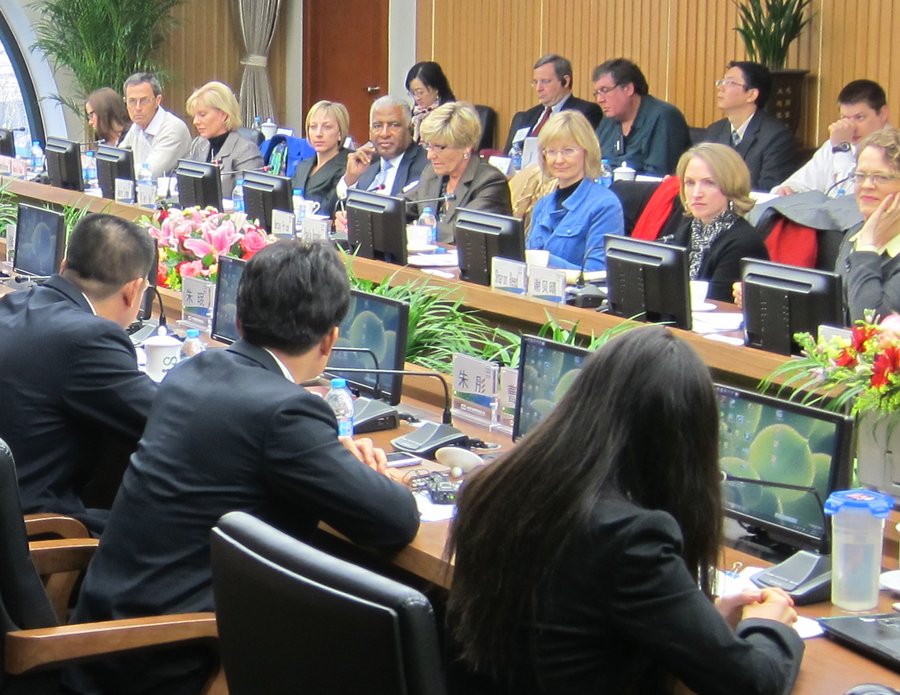
U.S. Department of Energy–MOHURD Ministerial Roundtable, Beijing
Publications
Published work & editorial contributions
Author
Walking the Heart Path Personal reflections across three decades of life and leadership
Guided Reflections on Becoming an Authentic Leader
A leadership workbook developed for reflective practice and adapted for client engagements, including the CREW Charlotte/KPMG women’s leadership program and the Mecklenburg County Bar Leadership Institute. Originally a Heart by Design publication, now carried forward through HBD Global.
Co-Editor
Deloitte Human Capital Trends — Financial Services
Deloitte’s flagship annual human capital research, drawn from a global survey of business and human resources leaders across many countries and sectors. 2021 & 2023
Co-Editor
Voices of Change
A UN Women publication drawn from a global campaign of 300+ contributed stories representing 83 countries, released at the United Nations Headquarters during the 60th Session of the Commission on the Status of Women (CSW60)
Author
Innovation Series
Commissioned by the McColl Center for Art & Innovation to develop and author a series on the business and social impact of innovation and the creative process. 2014–2015
Founder & Editor
The Global Girls Project
An online journalism and storytelling initiative on character-based leadership and empowerment, reaching more than 60 countries. First-person stories from women and girls traced sixteen principles of character into voice and leadership, alongside two interview series — Leaders as Learners and Leaders as Influencers of Change — featuring key voices from USAID, Brookings, the Cherie Blair Foundation for Women, and Oxford’s Saïd Business School. Recognized with the ATHENA Women’s Leadership Award.
HBD Field Notes
Notes from the crossroads.
On leadership, ethics, complexity, and what it means to remain human by design.
Five Lenses
Context
Zoom out. See the whole.
Movement
Navigate complexity.
Direction
Choose with intention.
Journey
Travel the path.
Insight
Notice what matters.
Audio interview
coming soon
Field Note No. 01 · Context
Human by Design
If AI lets you finish in six hours what used to take eight, what happens to the other two?
Most answers arrive fast, and most of them are about volume and speed. More output. More throughput. More of whatever we were already doing. Fewer people ask the question underneath it: what are we optimizing for, and why?
That question is where Human by Design starts.
Human by Design is a way of thinking about leadership, organizations, and change that begins with purpose, understands context, and then deliberately cultivates the human capabilities technology cannot replace. It is both a worldview and an operating principle, which means it has to show up in how things get built and executed, not only in how they get described.
In practice, that means designing the conditions that let people, teams, organizations, and communities think clearly, exercise sound judgment, collaborate well, and move forward together. The conditions come first, not the org chart.
None of this is a reaction to AI. The questions predate this moment by decades. But AI has raised the stakes and shortened the timeline.
At the heart of this work are three enduring questions
How does a person remain fully human inside systems that ask something different of them?
In an age of relentless optimization, where the speed of transaction outruns the capacity for curiosity, courage, or depth of connection, how do we keep these capabilities in practice rather than theory?
And are we cultivating them deliberately, or assuming they will survive on their own?
As you reflect on what it means to be Human by Design in your own context, what are you optimizing for, and why?
If my earlier work and writing focused on what it means to lead from within, recent years have invited altogether different questions.
How do we lead effectively in context?
Beyond the work of becoming our authentic selves, how do we balance inner alignment with the outer responsibility of leading our teams, organizations, and those broader communities we serve?
How do we work within systems where structural, financial, cultural, and/or performance incentives often shape behavior more than the moral premise of a given leader?
As I write this, important work is underway at institutions like Oxford and Wake Forest to develop leaders grounded in character and values.
Skills alone are insufficient, and character is foundational to developing tomorrow’s leaders. Foundational, but not sufficient. The ethics of AI and the ever-increasing focus on optimizing speed, efficiency, and profit have accelerated this conversation. What’s not new is the need to exercise good judgment: to understand competing and often shifting values, incentives, and levers, and to navigate the inevitable trade-offs effectively.
Decades ago, while working in economic development, I represented a global consumer company considering the acquisition of an existing manufacturing facility of a competitor in decline. I was asked and agreed to keep the announcement confidential until the company could communicate the deal with employees, knowing that some roles would be eliminated, while others would be critical to retain for the future success of the operation. As the project lead, I assumed I had the authority to make and keep that promise, failing to consider larger organizational dynamics at play.
The next morning, the deal appeared prominently in one of the city’s major business publications — not because I broke my commitment, but because the senior leadership I served within my organization made a different calculation about what served the institution best. In that moment, unbeknownst to me, the organization chose to optimize for visibility, timing, and media leverage over a promise a project lead made on its behalf. My client felt understandably betrayed. I had kept my word. And yet, in a meaningful sense, we had not.
I have never forgotten that moment, or the questions it left me with:
What does integrity require when the individual and the institution are operating from different commitments?
What authority does a leader need to honor a promise?
When two competing values clash, what guides your choice in determining the highest good or course of action?
And what happens when the system rewards behavior that undermines the very trust its people are expected to build?
At some point in nearly every leader’s career, character alone will not resolve the choice. Competing obligations will require trade-offs, and every available option may carry a cost.
As you reflect on what it means to lead in context, I invite you to consider the questions above in your own leadership journey. From an organizational design perspective, where are those places where structural incentives conflict with the stated goals, values, or culture? From a capital and technology standpoint, what guardrails and governance structures can withstand the pressure to optimize efficiency and profit?
Regardless of whether one agrees with a given company’s mission or its leaders’ values, I’m often inspired by those who act on the courage of their convictions — their lived values reflected in how they treat their employees, serve their customers, and operate their business.
An organization’s ability to live its values depends on more than the character or moral premise of its leaders. Behaviors at every level of an organization are shaped and influenced by structure, culture, incentives, and levers, and capital structure may be one of the most important, and most overlooked, parts of that structure.
Earlier this fall, a local operator invited me to tour Chick-fil-A’s Support Center in Atlanta, along with leaders from his two restaurants in the Winston-Salem area. (A disclosure: my husband leads HR and talent for that operator, so I’ve had a chance to witness parts of the system up close for some time.) We spent the day touring the campus and meeting leaders from across the company — from operations to leadership development.
Three things stayed with me.
The first was operational excellence. The building and grounds, the exceptional service, the attention to every detail. Just as striking, the commitment of each employee to their work, wherever their work may sit or whatever it may entail.
The second was harder to measure, but palpable nonetheless. Deep joy. A servant’s heart. And a sense that felt genuine rather than performed. Joy is different from happiness or surface positivity. It is not transactional or dependent upon ideal circumstances. Rather, it comes from within. Light emanating outwards. Infectious in spirit. Deeply relational.
The third was generosity, born of deep confidence. Not in the conventional sense, although Chick-fil-A is a deeply generous company in many ways. Rather, what struck me was their willingness to share what they know, including part of what makes them successful. Not only with their employees and operators, but with their competitors as well. One of our hosts told us about the time Boston Market approached Chick-fil-A, asking about their model. A direct competitor at the time, Boston Market was invited to the Support Center to learn. How many companies open their doors to a competitor?
Driving home, I kept asking what made all that possible. Not just a single decision, but the continuity of values across the entire organization.
Part of the answer is ownership. Chick-fil-A is privately held by the Cathy family, so a values-based decision like closing every Sunday can survive a quarterly earnings call. A publicly traded company might believe in a day of rest just as sincerely and still find it extremely hard to give up a full day of sales every week, year after year. Private ownership doesn’t guarantee principled leadership, any more than public ownership precludes it. But different ownership structures create different freedoms, pressures, and trade-offs.
In the case of Chick-fil-A, while the ownership structure is core, what struck me is how context nests inside context. The family’s ownership shapes the Support Center. The Support Center shapes how operators work. And each operator shapes the culture of their own restaurants.
The balance between those layers is where it gets interesting. Chick-fil-A’s model combines significant central control with meaningful local discretion. Some decisions are held centrally and are non-negotiable. Every restaurant closes on Sunday. Every operator works under the same agreement. And there can never be an intentionally misspelled sign without suggesting that the cow painted or wrote it. But inside that frame, operators have real agency. They decide whom to hire, how to pay, what benefits to offer, and how to build their teams. The core values are held in common, while judgment remains local.
The distributed model can work under different ownership and governance structures, but the strength of the shared core is what makes this particular balance possible. When the foundation is secure, you can afford to give people freedom within it. And on occasion, you can even afford to teach your competitors.
Most organizations don’t have an owner who can simply decide to close on Sundays. Their owners may be dispersed, distant, or focused on the next quarter. Their leaders may hold values every bit as strong and still find themselves constrained by structures and incentives that reward decisions at odds with those values. As I wrote in an earlier note, character is foundational, but not sufficient.
So, the question becomes more than whether an entity or leader courageously lives its convictions. It’s where those values live and the systems that support them.
As you reflect on your own organization, I invite you to consider:
Where do your values live beyond the poster on the wall?
What are the agreed-upon values, and where do people have room to use their own judgment?
Importantly, what does it take to create an organization in which doing what you believe is right isn’t an act of individual courage, but something the system itself makes possible?
More to come this fall — dispatches from three decades spent working at the intersections of strategy, human systems, and the problems frameworks alone cannot solve.
About
Sharon E. Reed Principal, HBD Global
Sharon Reed is a strategist, convener, and bridge-builder with thirty years of experience working at the intersection of organizational strategy, human systems, and complexity.
Her career spans Big Four consulting to Fortune 50 clients at KPMG and Deloitte, international development with UN Women and the US Department of Energy, civic leadership as Executive Director of Charlotte’s International Cabinet, and independent practice through HBD Global.
Raised across Australia, Singapore, and the UK before returning to the US, Sharon brings a genuinely global lens to her work — one shaped by direct experience of how cultural context shapes leadership, decision-making, and organizational life.
She is the author of Walking the Heart Path (Bronze IPPY Award · Gold Living Now Book Award) and is currently working on her second book, You Can’t Outperform a Bad Fit. She holds an MA in International Affairs from Florida State University.
Sharon lives in Winston-Salem, North Carolina, with her husband Thom and beloved doodle, Buddy. She is a lifelong visual thinker who draws inspiration from art, music, meaningful conversations, travel, nature, and the big ideas that elevate humankind.
Read the longer story — how a decade of personal writing on Walking the Heart Path and the original Heart by Design brand became HBD Global.
Sharon E. Reed — Principal, HBD Global LLC
Photo: Piper Warlick Photography
“The true power of any community or collective to solve complex problems and influence lasting change begins and ends with relationships and the true spirit of collaboration.”
Walking the Heart Path
For thirty years, Sharon has moved between two worlds that most people keep separate: the strategic, analytical work of international affairs, economic development, and Fortune 50 consulting, and a quieter creative practice of writing and visual art. For a long time she treated them as parallel tracks. It took years to recognize they were never separate at all — the same discipline that maps a five-year strategy shows up in a stanza; the same instinct that reads a boardroom reads a canvas. One practice sharpens the other.
A single point, expanding outward through team, organization, and community — the mark, explained.
Privacy
This site does not use cookies, tracking scripts, or third-party analytics. Information you share through a form on this page, or by email, is used only to respond to you, and is never sold or shared with third parties. If that changes as this site grows, this notice will be updated to reflect it.
Let’s Connect
The question underneath the question.
If your team, institution, or partnership is facing a critical moment, let’s start with a 30-minute conversation. We’ll clarify what you’re navigating, what may be getting in the way, and how best to begin, or whether another partner would serve you better.