Where Values Live
Regardless of whether one agrees with a given company’s mission or its leaders’ values, I’m often inspired by those who act on the courage of their convictions — their lived values reflected in how they treat their employees, serve their customers, and operate their business.
An organization’s ability to live its values depends on more than the character or moral premise of its leaders. Behaviors at every level of an organization are shaped and influenced by structure, culture, incentives, and levers, and capital structure may be one of the most important, and most overlooked, parts of that structure.
Earlier this fall, a local operator invited me to tour Chick-fil-A’s Support Center in Atlanta, along with leaders from his two restaurants in the Winston-Salem area. (A disclosure: my husband leads HR and talent for that operator, so I’ve had a chance to witness parts of the system up close for some time.) We spent the day touring the campus and meeting leaders from across the company — from operations to leadership development.
Three things stayed with me.
The first was operational excellence. The building and grounds, the exceptional service, the attention to every detail. Just as striking, the commitment of each employee to their work, wherever their work may sit or whatever it may entail.
The second was harder to measure, but palpable nonetheless. Deep joy. A servant’s heart. And a sense that felt genuine rather than performed. Joy is different from happiness or surface positivity. It is not transactional or dependent upon ideal circumstances. Rather, it comes from within. Light emanating outwards. Infectious in spirit. Deeply relational.
The third was generosity, born of deep confidence. Not in the conventional sense, although Chick-fil-A is a deeply generous company in many ways. Rather, what struck me was their willingness to share what they know, including part of what makes them successful. Not only with their employees and operators, but with their competitors as well. One of our hosts told us about the time Boston Market approached Chick-fil-A, asking about their model. A direct competitor at the time, Boston Market was invited to the Support Center to learn. How many companies open their doors to a competitor?
Driving home, I kept asking what made all that possible. Not just a single decision, but the continuity of values across the entire organization.
Part of the answer is ownership. Chick-fil-A is privately held by the Cathy family, so a values-based decision like closing every Sunday can survive a quarterly earnings call. A publicly traded company might believe in a day of rest just as sincerely and still find it extremely hard to give up a full day of sales every week, year after year. Private ownership doesn’t guarantee principled leadership, any more than public ownership precludes it. But different ownership structures create different freedoms, pressures, and trade-offs.
In the case of Chick-fil-A, while the ownership structure is core, what struck me is how context nests inside context. The family’s ownership shapes the Support Center. The Support Center shapes how operators work. And each operator shapes the culture of their own restaurants.
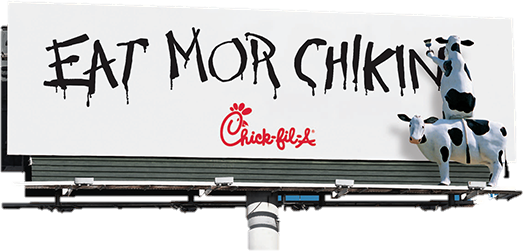
The balance between those layers is where it gets interesting. Chick-fil-A’s model combines significant central control with meaningful local discretion. Some decisions are held centrally and are non-negotiable. Every restaurant closes on Sunday. Every operator works under the same agreement. And there can never be an intentionally misspelled sign without suggesting that the cow painted or wrote it. But inside that frame, operators have real agency. They decide whom to hire, how to pay, what benefits to offer, and how to build their teams. The core values are held in common, while judgment remains local.
The distributed model can work under different ownership and governance structures, but the strength of the shared core is what makes this particular balance possible. When the foundation is secure, you can afford to give people freedom within it. And on occasion, you can even afford to teach your competitors.
Most organizations don’t have an owner who can simply decide to close on Sundays. Their owners may be dispersed, distant, or focused on the next quarter. Their leaders may hold values every bit as strong and still find themselves constrained by structures and incentives that reward decisions at odds with those values. As I wrote in an earlier note, character is foundational, but not sufficient.
So, the question becomes more than whether an entity or leader courageously lives its convictions. It’s where those values live and the systems that support them.
As you reflect on your own organization, I invite you to consider:
Where do your values live beyond the poster on the wall?
What are the agreed-upon values, and where do people have room to use their own judgment?
Importantly, what does it take to create an organization in which doing what you believe is right isn’t an act of individual courage, but something the system itself makes possible?
Leading in Context
If my earlier work and writing focused on what it means to lead from within, recent years have invited altogether different questions.
How do we lead effectively in context?
Beyond the work of becoming our authentic selves, how do we balance inner alignment with the outer responsibility of leading our teams, organizations, and those broader communities we serve?
How do we work within systems where structural, financial, cultural, and/or performance incentives often shape behavior more than the moral premise of a given leader?
As I write this, important work is underway at institutions like Oxford and Wake Forest to develop leaders grounded in character and values.
Skills alone are insufficient, and character is foundational to developing tomorrow's leaders. Foundational, but not sufficient. The ethics of AI and the ever-increasing focus on optimizing speed, efficiency, and profit have accelerated this conversation. What’s not new is the need to exercise good judgment: to understand competing and often shifting values, incentives, and levers, and to navigate the inevitable trade-offs effectively.
Decades ago, while working in economic development, I represented a global consumer company considering the acquisition of an existing manufacturing facility of a competitor in decline. I was asked and agreed to keep the announcement confidential until the company could communicate the deal with employees, knowing that some roles would be eliminated, while others would be critical to retain for the future success of the operation. As the project lead, I assumed I had the authority to make and keep that promise, failing to consider larger organizational dynamics at play.
The next morning, the deal appeared prominently in one of the city's major business publications — not because I broke my commitment, but because the senior leadership I served within my organization made a different calculation about what served the institution best. In that moment, unbeknownst to me, the organization chose to optimize for visibility, timing, and media leverage over a promise a project lead made on its behalf. My client felt understandably betrayed. I had kept my word. And yet, in a meaningful sense, we had not.
What does integrity require when the individual and the institution are operating from different commitments?
What authority does a leader need to honor a promise?
When two competing values clash, what guides your choice in determining the highest good or course of action?
And what happens when the system rewards behavior that undermines the very trust its people are expected to build?
At some point in nearly every leader's career, character alone will not resolve the choice. Competing obligations will require trade-offs, and every available option may carry a cost.
As you reflect on what it means to lead in context, I invite you to consider the questions above in your own leadership journey. From an organizational design perspective, where are those places where structural incentives conflict with the stated goals, values, or culture? From a capital and technology standpoint, what guardrails and governance structures can withstand the pressure to optimize efficiency and profit?
Human by Design
If AI lets you finish in six hours what used to take eight, what happens to the other two?
Most answers arrive fast, and most of them are about volume and speed. More output. More throughput. More of whatever we were already doing. Fewer people ask the question underneath it: what are we optimizing for, and why?
That question is where Human by Design starts.
Human by Design is a way of thinking about leadership, organizations, and change that begins with purpose, understands context, and then deliberately cultivates the human capabilities technology cannot replace. It is both a worldview and an operating principle, which means it has to show up in how things get built and executed, not only in how they get described.
In practice, that means designing the conditions that let people, teams, organizations, and communities think clearly, exercise sound judgment, collaborate well, and move forward together. The conditions come first, not the org chart.
None of this is a reaction to AI. The questions predate this moment by decades. But AI has raised the stakes and shortened the timeline.
How does a person remain fully human inside systems that ask something different of them?
In an age of relentless optimization, where the speed of transaction outruns the capacity for curiosity, courage, or depth of connection, how do we keep these capabilities in practice rather than theory?
And are we cultivating them deliberately, or assuming they will survive on their own?
As you reflect on what it means to be Human by Design in your own context, what are you optimizing for, and why?
More to come this fall — dispatches from three decades spent working at the intersections of strategy, human systems, and the problems frameworks alone cannot solve.
← Back to Field Notes